
We’ve taken three domestic flights as a family so far this year, two within a span of four weeks. It’s about as easy as it’s ever been to book a flight these days. Whether that flight will actually take off on time—or at all—and reach its intended destination is another question. Airlines did not take advantage of the lull in air travel in the last three years to get their affairs in order, nor the recent resurgence in demand to staff up properly.
An added wrinkle, when flying with a toddler, is determining the proper seats to book. There are general rules of thumb that are true regardless of airline or plane body: short flights, direct flights when possible, seats near the restrooms, et cetera. But there are still a baffling array of options to choose from.
For instance, on our preferred airline, JetBlue, I can book:
- Blue Basic
- Blue
- Blue Extra
“Blue Extra” is distinct from Blue in that it offers early boarding and expedited security. However, we can also board early—though not as early as the Blue Extra bookers—because we fly with a young child who needs assistance getting settled. And I can still add “Priority Security” to a Blue fare. Fare class has no bearing on seat class, though: Blue Basics, Blues, and Blue Extras alike may choose an “Even More Space” seat for an additional fee. “Blue Basic” allows you to bring on one personal bag but not one carry-on bag, though if you book with JetBlue’s preferred credit card, you are entitled to one free checked bag per passenger.
And if you come down with COVID you might be canceling all this anyway, so read the policy on refundable fares closely.
This proliferation of seats was sold to the American consumer as an increase in “choices.” Frank Lorenzo, the corporate raider who bought Continental Airlines in 1981, is credited as the pioneer of lowering airline fares by introducing new choices in seat classes. In air travel, as in every other consumer-facing industry I can think of, introducing “choice” meant reducing the quality of the existing offering, selling the cheaper and shabbier version as a “value.” Customers who preferred the original offering are always welcome to pay more. But reducing the price of the original offering, or continuing to provide it at a price consistent with inflation, is never part of the plan.
The division of airplane seats into “business” class vs “coach” class—and further subdivisions; JetBlue is downright austere compared to its competitors—has nothing to do with the function of the plane. Business class passengers weigh as much per capita as coach passengers. Their luggage, food needs, and restroom usage are about the same. Replacing the more spacious business-class seats with coach-class seats would allow airlines to pack more passengers aboard. But creating this artificial distinction serves two functions:
- It lets the airline practice price discrimination, the ability to charge more for people who are willing to pay more. Business-class passengers are usually expensing their fare to an employer or client, who can account for the increased price as a business expense. Leisure travelers, who usually have a limited vacation budget and fewer options to write it off, don’t have that option. Having flown first class a few times, I can assure you that it is indeed nicer. I can also assure you that, by any objective accounting of inches of seat width and pitch per dollar, it’s not worth it.
- It serves as a subtle form of marketing. Coach passengers shuffle past the first-class flyers. They note their spacious, clean seats and the way flight attendants dote on them. Like a Patek Philippe watch ad in the back of Sports Illustrated, it gives the middle-income consumer something to aspire to someday. It puts a dream in their head. And if that dream only pays off once—splurging on a first-class seat for a special trip; picking one airline over another when you get to travel for work—that’s still added value that the airline didn’t have to pay for.
I had these functions in mind when I read professional sycophant Megan McArdle’s Washington Post op-ed the other week: “Want employees to return to the office? Then give each one an office.” As someone who’s written extensively about working conditions in the information economy during the pandemic, I was at first inclined to chalk this up as a broken clock giving the right time. But, like the man said, you do not, under any circumstances, gotta hand it to McArdle.
McArdle starts by noting some backlash she received for a prior column in which she discouraged young women from applying to jobs that could be done fully remote and with little direct supervision (“lazy jobs”). To prove her impartiality, McArdle turns to the employer side of the equation with some unsolicited advice:
Why not give those workers offices worth returning to?
And I mean this literally: offices. Not open floor plans where people can hear every word, sneeze and gum-chew that comes from a co-worker’s mouth. Nor dispiriting cubicles that make them feel like rats in a maze. But small rooms with desks and doors that close.
[…]
Bosses are presumably well aware of these drawbacks, since so many of them arrange to have, you know, offices. Surely, they can understand how employees might find offices enticing, too.
If only the leader knew!
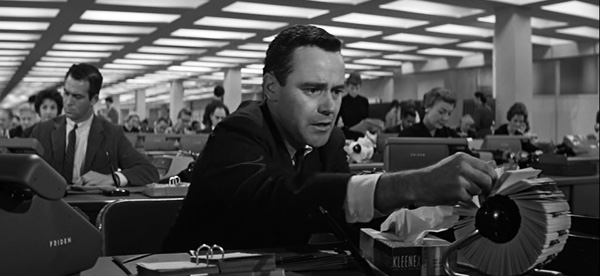
The open office, of course, predates the post-Nixon expansion of the finance, insurance, and real estate (FIRE) sectors—the white-collar boom, the rise of the yuppie, America’s transition away from manufacturing and toward services. But it was the (first) tech bubble that made open offices seem hip rather than soulless. Startup firms flooded with venture capital needed to expand quickly from garages and college campuses into “real” offices. This often meant converting space from a prior, abandoned use—urban industry—into office space. Lease a warehouse, throw up some drywall, run some CAT5, and voila! We can’t give everyone an office; we don’t have time to build offices. We’re moving fast, we’re breaking things.
(Throughout this essay, as in McArdle’s column, I’m of course talking about private sector service firms. We don’t need to speculate whether workers on an assembly line—in 1920, in 2020, in any era—would prefer an office with a door.)
But what once seems cutting-edge quickly becomes ubiquitous. What started as a cost-saving measure for bootstrapping firms becomes a cost-cutting measure for the entrenched firms that they were disrupting. And what was once a hallmark of innovation is now everyone’s least favorite part of the office.
McArdle is not wrong that rank-and-file employees hate open offices. She’s not even wrong per se about why:
[T]he open office certainly doesn’t help make workers want to come back. It is, as aforementioned, noisy, which makes it difficult to do any work that requires sustained concentration. Yet somehow, an open office also makes one reluctant to chat with co-workers or make important telephone calls, knowing that every word will have an audience of dozens, some of them visibly annoyed that your chitchat is derailing their train of thought. Tightly spaced desks in open offices also often feel cramped; everyone has just enough room to type without jostling elbows.
But she’s not correct, or not entirely correct, about why the open office floorplan persists. You can’t be a libertarian and understand how markets work. Comprehending economics interferes with libertarian thought. If you become one late in life, rather than in youthful enthusiasm, they excise the relevant bits of cortical matter with a grapefruit spoon.
She acknowledges the cost savings: thirty people take up much less space in an open floorplan than in thirty distinct offices. She even nods to the coming commercial real estate apocalypse, as billions of dollars in office leases are due to expire in the next few years. But it’s not primarily about cost and it never has been.
If you want to produce more of anything—insurance claims, ad copy, financial reports, widgets—you need either more work going into the product or a more efficient means of production. You need more labor or more capital. You need more work (longer hours, more staff) or more efficient work. As work gets more efficient through advances in technology or practice, firms tend to downsize. A typing pool full of secretaries gets replaced by one assistant with Microsoft Office. But a firm can’t grow on efficiency alone. So they have to hire more and more such assistants until you once again have a floor full of entry-level employees, only now they’re called “knowledge workers” rather than “secretaries.”
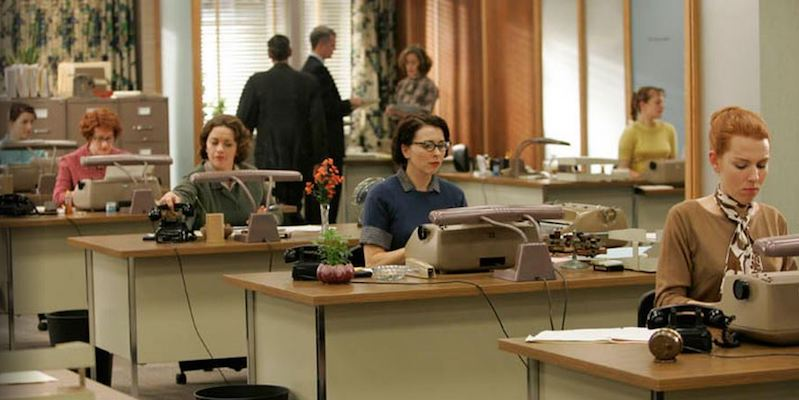
So even the most efficient firm, if it wants to grow, will need to expand its headcount. And any firm subject to the whims of the market—either dependent on finance or competing with firms that are—must grow or die.
As a firm grows to a certain scale, it becomes harder for its owners to make sure the work is getting done. This is true of all enterprises. In a cottage industry, the householder can peek over his family members’ shoulders. In a small shop, the master loses sight of his apprentices every once in a while. On a factory floor, the owner has to hire foremen to keep the assembly line up to speed. A global enterprise requires directors, vice presidents, presidents, and chiefs.
(They call this the principal-agent problem in the academic literature)
A manager may be responsible for the output of a team of ten subordinates, but they do not receive ten times their subordinates’ salary. An employee may know more about the day-to-day operations of the business than their director, but the employee must still defer to the director’s wishes. How can this be enforced? Salary and bonuses are the obvious levers, but these are tough to tie to specific goals. There’s always the threat of firing, but that arrow can only be loosed once. Besides, interviewing to refill a role is a pain.
But a series of modest perks can work wonders:
- A private office lets employers reward staff who are willing to work harder in service of the firm. Being a manager means making the firm’s values your own. You can bond with your direct reports, but you also have to be able to fire them if they’re not hitting their numbers. That requires a certain degree of alienation from the people you see everyday. What better place to retreat from the pleading eyes of your colleagues than a 9’x8′ room?
- A private office also serves as a subtle form of marketing. It reminds employees that your manager, no matter what you think of them, has a value to the firm that you lack. It reminds managers that they are separate—physically distinct—from the people who produce the firm’s actual output. It’s a lure to the ambitious and a goad to the rebellious.
The chief task of any capitalist enterprise is not generating profits or reducing costs. It’s maintaining control. A worker is asked to give their employer seven or more hours of their day to produce a good or service that the worker will not directly benefit from. The wage they receive is excellent motivation, especially if there is no easy alternative to wage labor. But even that won’t last forever. And if an employer concedes control over their employees, they concede the ability to swap out laborers as easily as they might swap out laptops.
You can tell the workplace struggle is a question of control, not of revenue, when employers fight for control at the expense of lost revenue. Starbucks is letting its contract with Cornell University expire rather than ease up on union-busting. Entertainment studios and streaming platforms wait out the WGA and SAG-AFTRA strikes with bad faith offers, even in the face of a season with no new media. Facebook has pulled news links from Canadian users’ feeds, even in the face of historic wildfires. Uber was willing to pull its service from Minneapolis in the face of a recent city ordnance guaranteeing a minimum wage to their drivers, and only backed down when the mayor vetoed a recent measure and negotiated a private compromise. Zoom is dragging staff back to the office in defiance of their product’s chief value proposition. And it took an astonishing level of organizing, agitation, and the credible threat of a strike for UPS to come back to the table with a contract that ended the two-tier wage system.
McArdle’s column lists every benefit of private working space within an office except one: a visible distinction that reinforces existing hierarchies. It’s an understandable oversight. The libertarian fantasy treats every commercial exchange—between customer and retailer, between employee and supervisor, between the hirer and the fired—as a free exchange between equals. It recognizes no coercion in the private sphere. It has no concept of power beyond naked force.
But this model of economic coercion, like the libertarian fantasy, is on its way out. Commercial leases are expiring and not being renewed. Workers are finding and exercising remarkable power over their own jobs, despite the best efforts of employers and the Federal Reserve. And all of us bear vivid memories of who is “essential”—and how that “essential” work will be rewarded—from the start of the pandemic.
We’ve been given the briefest glimpse of another way of ordering the economy: a fabulous party, overheard through a swinging door while we toil over the dishes. We know we can do better than McArdle’s vision of a slightly more equitable corporate future. We know a better world is possible. The next step is to build it.
Ideas are cheap; labor is dear.